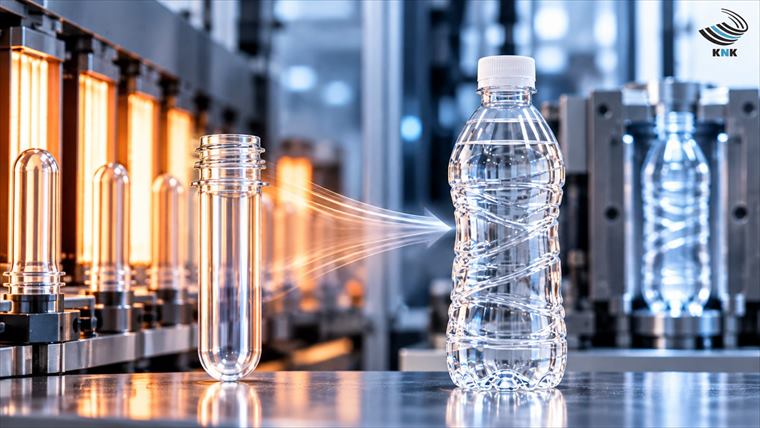
Why Do PET Preforms or Bottles Become Hazy, Yellow, or Brittle? A Scientific Troubleshooting Guide
2026/11/04
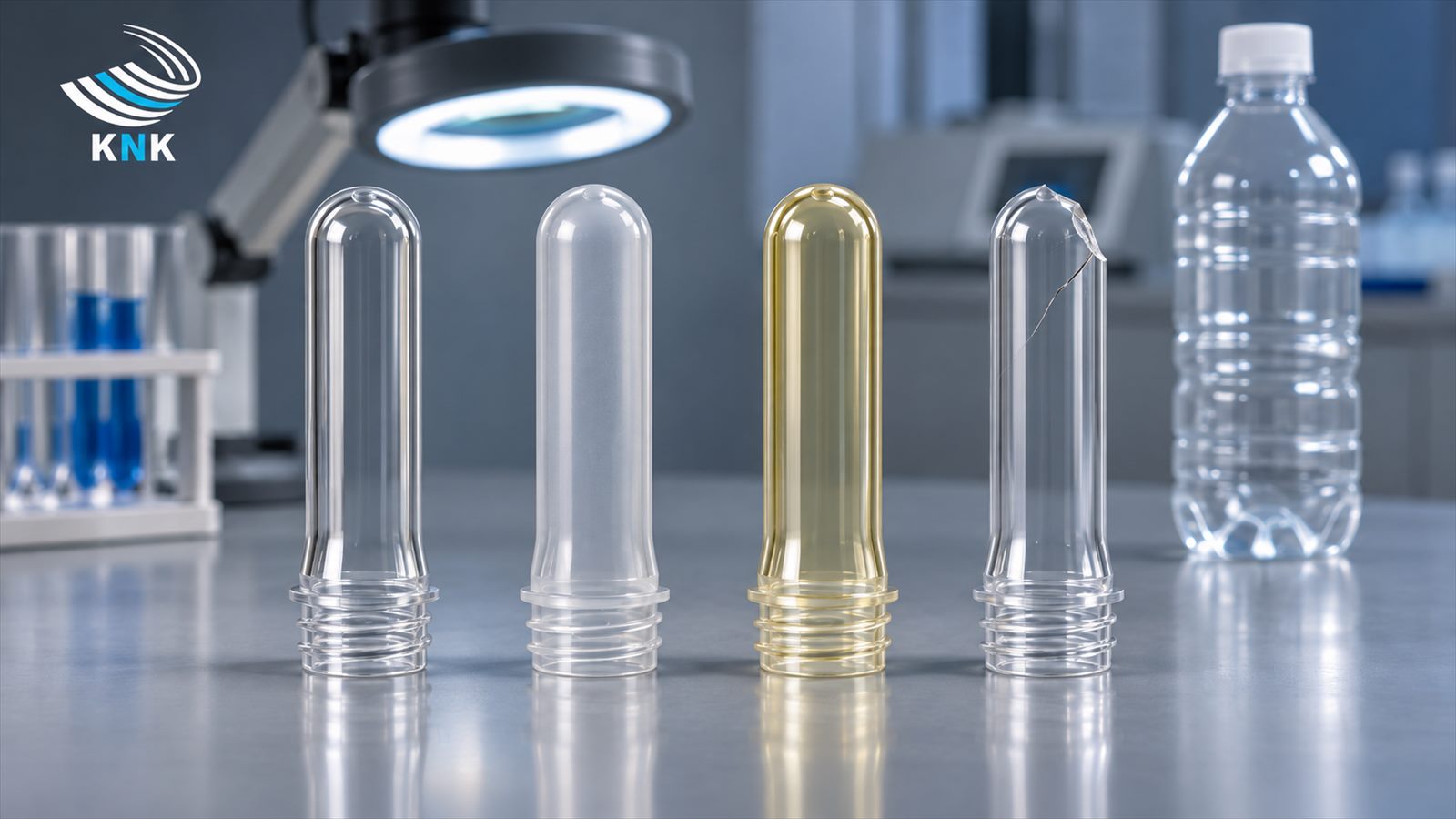
Haze, yellowing, and brittleness in PET preforms and bottles are different defects that may result from crystallization, moisture, contamination, thermal history, or processing conditions. Correct troubleshooting requires identifying when the defect appears and distinguishing material problems from injection molding, cooling, or stretch blow-molding issues.
Why Can’t PET Defects Be Diagnosed by Appearance Alone?
A PET preform may appear cloudy or milky, another may develop a yellow tint, while a visually clear preform may behave more brittlely during testing or subsequent processing.
These symptoms do not necessarily have the same cause.
Haze may be associated with crystallization, contamination, cooling conditions, or thermal history. Yellowing may indicate thermal or thermo-oxidative degradation. Brittleness may be related to hydrolytic degradation, molecular-weight reduction, IV loss, or repeated processing.
For this reason, professional PET troubleshooting should begin by identifying the type of defect and the stage at which it first appears, rather than assigning a cause from appearance alone.
What Is the Difference Between Haze, Crystallization, and Pearlescence?
Haze describes a loss of transparency caused by light scattering within a material. Crystallization refers to the formation of more ordered regions within PET. If these crystalline structures become large enough to scatter visible light, a normally transparent preform may appear cloudy or milky.
Pearlescence, however, is typically associated with Stretch Blow Moulding. It can occur when PET is stretched under unsuitable temperature or deformation conditions, producing a whitish or pearlescent appearance.
Therefore, a cloudy injection-molded preform and a bottle that becomes white only after blow molding should not automatically be treated as the same defect.
Why Does a PET Preform Become Cloudy or Milky?
Transparent PET preforms generally require controlled and sufficiently rapid cooling after injection molding to limit unwanted crystallization.
If PET remains too long in a temperature range that promotes crystal growth, increased crystallization can reduce optical clarity.
However, crystallization is not the only possible cause of haze. Resin contamination, unsuitable processing conditions, thermal degradation, cooling problems, or material mixing can also affect transparency.
This is why haze should be evaluated together with the defect location, production history, resin condition, and cooling performance.
How Does Moisture Affect PET?
PET is a hygroscopic material, meaning it absorbs moisture from the surrounding environment.
If PET contains excessive moisture during melt processing, water can promote hydrolytic degradation, causing polymer-chain scission and potentially reducing molecular weight and Intrinsic Viscosity (IV).
This can affect processing stability and mechanical properties.
However, moisture should not be blamed for every cloudy or brittle preform. Drying performance must be evaluated together with resin quality, temperature, residence time, injection conditions, and cooling.
Why Can a PET Bottle Turn White After Blow Molding?
If the preform is transparent before entering the blow moulder but white or pearlescent areas appear in the finished bottle, Pearlescence should be considered.
During Stretch Blow Moulding, the preform must be heated into an appropriate processing window so that PET can stretch longitudinally and radially in a controlled way.
If the preform is too cold, or if stretch rate and deformation conditions are unsuitable, localized whitening can develop.
In this situation, engineers should review the Heat Profile, preform temperature, Stretch Ratio, deformation rate, and blowing conditions before concluding that the raw material is defective.
Why Does a PET Preform Turn Yellow?
Yellowing can be associated with Thermal Degradation or Thermo-oxidative Degradation.
Excessive thermal exposure or unnecessarily long residence time can trigger chemical changes in PET that shift its color toward yellow or brown.
Potential sources include unsuitable conditions in the dryer, injection barrel, hot runner, or other areas where material remains at elevated temperature for too long.
However, resin color, rPET quality, regrind, contamination, additives, and previous processing history can also influence the final color.
For quantitative color control, systems such as CIELAB can be used, with positive changes in the b* value indicating a shift toward yellow.
Why Does PET Become Brittle?
Brittleness is not always visible.
A preform may appear clear and dimensionally correct while showing weaker mechanical behavior during testing or further processing.
One possible mechanism is Chain Scission caused by hydrolytic, thermal, or repeated thermo-mechanical degradation. When molecular weight decreases, IV may also decrease, and the material can lose part of its ability to deform before failure.
Nevertheless, low IV alone does not prove that a preform is brittle. Crystallinity, thermal history, recycled-material quality, contamination, and processing stresses should also be considered.
Does Higher Crystallinity Always Mean Poorer PET Quality?
No.
PET is a semi-crystalline polymer, and crystallinity can be either useful or undesirable depending on the application.
In some heat-set processes, controlled crystallization is intentionally used to improve thermal stability. In a conventional transparent preform intended for Stretch Blow Moulding, however, uncontrolled crystallization can reduce transparency and interfere with proper blowing behavior.
The important question is therefore not whether PET contains crystalline regions, but whether the degree and type of crystallization are appropriate for the intended process and final product.
Does rPET Always Cause Haze, Yellowing, or Brittleness?
No.
The quality of recycled PET varies according to feedstock, recycling technology, contamination level, purification efficiency, and previous thermal history.
Some rPET grades may show higher haze or yellowness than virgin PET, but recycled content alone does not determine final quality.
Repeated processing can also contribute to molecular-weight and IV changes if the material is not carefully controlled.
For this reason, actual material quality and consistency are more important than simply classifying PET as virgin or recycled.
How Can We Tell Whether the Problem Comes from the Material or the Process?
Randomly changing machine settings is not an effective troubleshooting method.
The first step is to determine when the defect appears.
If a preform is clear before blow molding but turns white afterward, the Heat Profile and stretch-blow conditions should be investigated first. If yellowing is already visible in the preform, resin condition, regrind, dryer settings, processing temperature, residence time, and the hot runner should be reviewed.
If brittleness appears together with a measurable IV reduction, hydrolytic or thermal degradation becomes a stronger hypothesis.
When necessary, visual observations should be confirmed through laboratory testing.
Which Tests Help Diagnose PET Defects?
Optical haze can be measured using appropriate light-scattering instruments, while color changes can be quantified with a spectrophotometer and L*a*b* values.
Intrinsic Viscosity testing can provide information about possible molecular-weight changes, while resin-moisture measurements help evaluate drying performance.
DSC, or Differential Scanning Calorimetry, can also be used to study thermal behavior and crystallinity.
For more advanced investigations, mechanical testing, microscopy, contamination analysis, and acetaldehyde measurement may also be useful.
The most reliable diagnosis usually comes from combining visual inspection, process data, and laboratory evidence.
Why Are These Defects More Than Cosmetic Problems?
In water and beverage packaging, transparency and color directly influence the consumer’s perception of cleanliness and quality.
But these defects can also indicate deeper processing issues.
Yellowing may signal excessive thermal history. Brittleness may be associated with molecular degradation. Haze may indicate crystallization, contamination, or cooling problems.
Therefore, visual inspection of PET is not merely cosmetic control; it can also provide early evidence about the condition of the material and the stability of the production process.
PET Preform Quality and Production Consistency
For industrial users, one good-looking sample is not enough.
A reliable PET preform must maintain consistent weight, dimensions, color, neck quality, gate condition, thermal behavior, and blow-molding performance across large production volumes and repeated orders.
At Khosh Noosh Kavir (KNK), PET preform quality is approached through control of raw materials, drying, injection molding, cooling, and finished-product characteristics.
When a production line experiences changes in transparency, color, blow-molding behavior, or mechanical performance, evaluating the preform together with mould, blow-molding equipment, and real process conditions provides a more reliable basis for diagnosis than appearance alone.
Conclusion: Observe the Defect, but Measure the Cause
Haze, yellowing, and brittleness are not different names for the same PET problem.
Haze may be related to crystallization, contamination, or cooling conditions. Yellowing may indicate thermal or thermo-oxidative degradation. Brittleness may involve chain scission, hydrolysis, molecular-weight reduction, IV loss, or repeated processing.
A bottle that becomes white only after blow molding may instead be showing Pearlescence caused by Stretch Blow Moulding conditions.
The key troubleshooting principle is therefore simple:
Record the visible symptom, identify the stage where it first appears, review the process data, and use appropriate testing to confirm the cause.
In professional PET manufacturing, the most important question is not merely:
“What defect can we see?”
It is:
“At which stage, and through which mechanism, was this defect created?”
That distinction separates guesswork from engineering-based troubleshooting in PET preform and bottle production.
Latest Articles
What Is Intrinsic Viscosity (IV) in PET and Why Does It Matter for Preform and Bottle Quality?
What Is the Right PET Preform Weight for Mineral Water? A Guide to 29/25 PET Preforms