What Is Intrinsic Viscosity (IV) in PET and Why Does It Matter for Preform and Bottle Quality?
2026/11/02
Intrinsic Viscosity (IV) is an important PET parameter related to polymer molecular structure and can provide valuable information about resin condition and processing history. However, a higher IV does not automatically mean a better PET preform or bottle; the appropriate resin grade must match the application and production process.
What Is Intrinsic Viscosity (IV) in PET?
IV, or Intrinsic Viscosity, is a polymer property commonly used to characterize PET resin. It reflects the behavior of polymer chains in a dilute solution and is closely related to molecular size and molecular weight under defined test conditions. IV is usually reported in units such as dL/g.
In practical PET manufacturing, IV can help evaluate resin grade, material consistency, and possible changes in polymer structure during processing. However, IV should not be interpreted as a direct measurement of bottle strength.
How Is IV Related to PET Molecular Weight?
Intrinsic Viscosity is related to polymer molecular weight through relationships such as the Mark–Houwink equation. In general, when PET chains undergo significant chain scission, molecular weight decreases and IV usually decreases as well.
For this reason, a reduction in IV can be an indication that PET has experienced degradation during drying, melt processing, recycling, or repeated thermal exposure.
Scientifically, IV is better understood as a parameter related to the hydrodynamic size and molecular characteristics of polymer chains, rather than simply as a direct measure of “chain length.”
Does a Higher IV Always Mean Better PET?
No.
This is one of the most important points when interpreting PET specifications. Different Bottle Grade PET resins are intentionally produced with different IV values depending on their intended application.
Water bottles, carbonated beverage bottles, hot-fill containers, and large reusable water containers may require different resin characteristics.
A higher IV generally corresponds to different melt and molecular behavior, but this does not mean that the highest available IV is automatically the best choice.
The correct question is:
Which PET grade provides the appropriate balance of processing behavior and final product performance for the intended application?
How Can Moisture and Processing Affect PET IV?
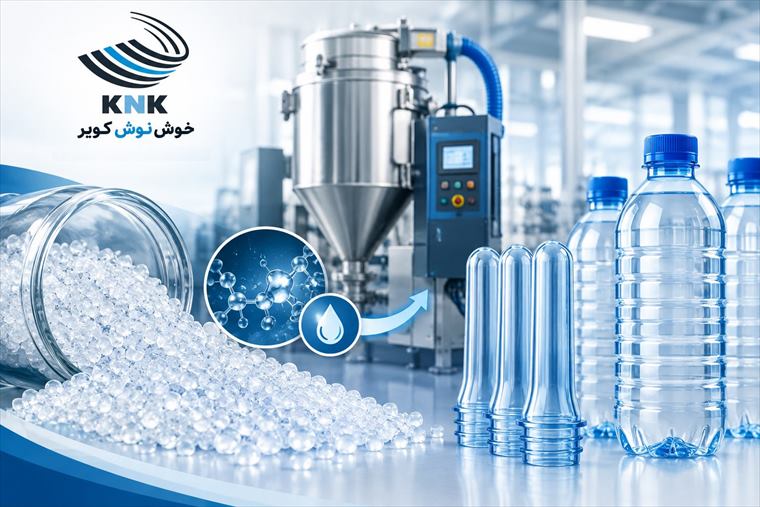
PET must be properly dried before melt processing. Excessive moisture at elevated processing temperatures can promote hydrolytic degradation, breaking polymer chains and potentially reducing molecular weight and IV.
Thermal history is also important. Excessive heat exposure, unnecessary residence time, repeated processing, and other unfavorable processing conditions can contribute to polymer degradation.
Therefore:
Raw-material IV and the IV of PET after processing are not necessarily identical.
This is why drying conditions and process stability are important not only for appearance and molding performance but also for preserving the molecular quality of PET.
What Does IV Mean for PET Preform and Bottle Production?
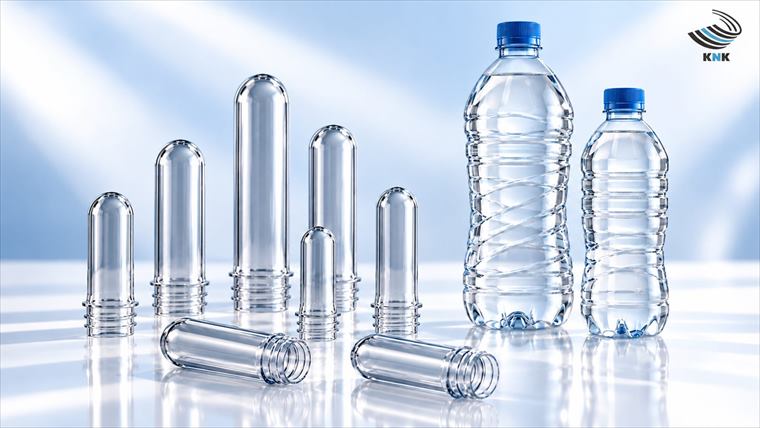
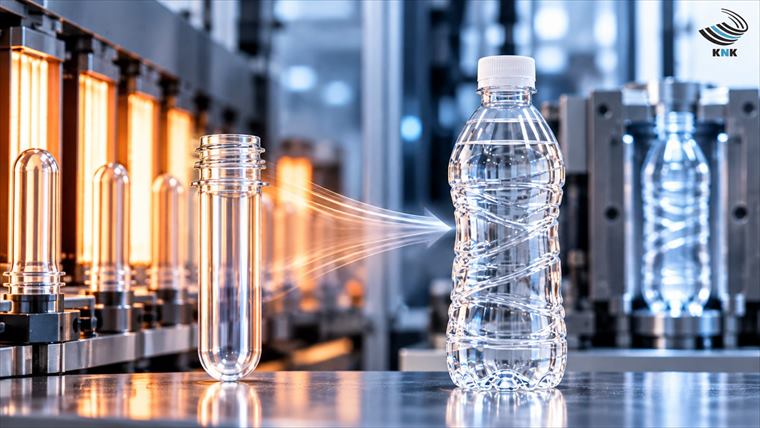
During PET preform production, resin is melted and injection-molded. During subsequent Stretch Blow Moulding, the preform is reheated and stretched into the final bottle.
IV influences the behavior of the PET material, but final bottle quality depends on many additional factors, including:
- preform design and weight;
- heat profile;
- stretch ratio;
- mould geometry;
- wall thickness distribution;
- molecular orientation;
- and blow-molding conditions.
For this reason, two bottles produced from PET with similar IV values can still show significantly different mechanical performance.
IV is an important part of the quality equation, but it is not the entire equation.
Are Intrinsic Viscosity and Inherent Viscosity the Same?
Not exactly.
Although the terms are sometimes used loosely in industrial discussions, Intrinsic Viscosity and Inherent Viscosity have different scientific definitions.
Intrinsic Viscosity refers to a limiting viscosity value as polymer concentration approaches zero, whereas Inherent Viscosity is calculated at a specified polymer concentration.
This distinction becomes important when comparing laboratory reports, supplier specifications, or results produced according to different standards. An IV value should therefore ideally be interpreted together with the test method and measurement conditions.
How Is PET IV Measured?
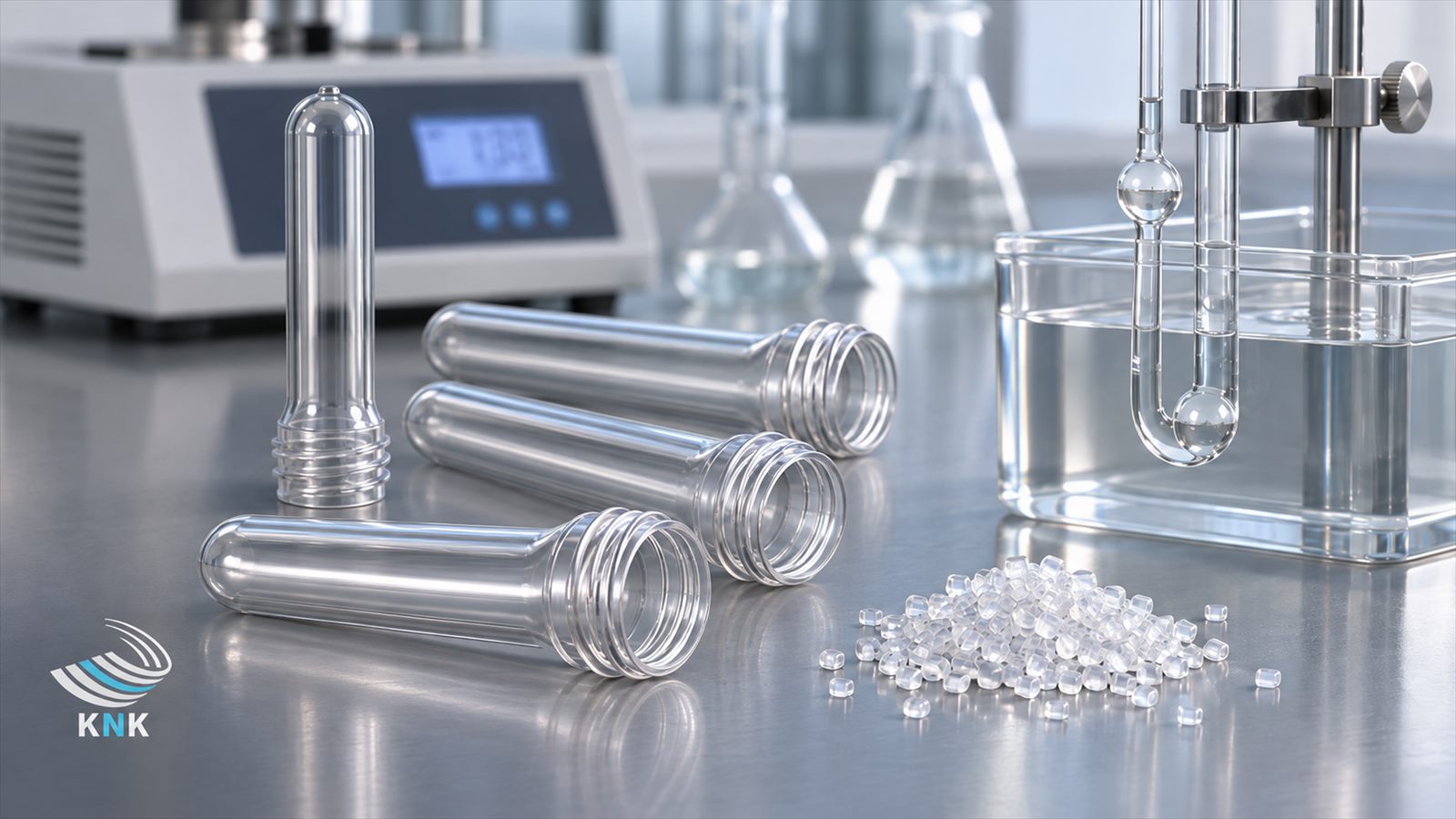
Traditional laboratory methods determine polymer solution viscosity using instruments such as capillary viscometers under carefully controlled conditions.
Standards such as ISO 1628-5 and ASTM D4603 describe methods used to evaluate the solution-viscosity behavior of thermoplastic polyesters.
The practical point for manufacturers and buyers is simple:
Two viscosity values should not automatically be compared unless the measurement methods and conditions are understood.
IV cannot be reliably determined from the appearance of a PET preform. A clear, dimensionally accurate preform may still require laboratory testing if precise molecular characterization is needed.
Why Is IV Important When Selecting PET Preforms?
For routine purchasing, buyers do not necessarily need to become polymer laboratory specialists. However, for high-volume production, sensitive applications, supplier changes, recycled PET use, or technically demanding projects, understanding the resin grade and consistency can be valuable.
Instead of asking only:
“What is the IV of this preform?”
a more useful question is:
“Is the PET grade and its processing stability appropriate for my bottle, product, and production line?”
The answer should consider the beverage type, neck finish, preform weight, bottle design, closure, mould, blow-molding conditions, and final mechanical requirements.
IV and Recycled PET
IV is also an important parameter when evaluating rPET, because recycled material may already have experienced one or more previous thermal and processing cycles.
Repeated processing can contribute to chain scission and changes in molecular weight if the material and process are not properly controlled.
However, IV alone cannot determine recycled PET quality. Contaminants, color, volatile compounds, thermal history, recycling technology, and overall material consistency must also be considered.
Conclusion: IV Matters, but It Is Only One Part of PET Quality
Intrinsic Viscosity is an important engineering parameter for understanding PET resin and its processing history. It can provide useful information about molecular characteristics, resin grade, and possible polymer degradation.
However, higher IV does not automatically mean a better PET preform or bottle.
The appropriate IV must be considered together with moisture control, resin grade, acetaldehyde, preform design, weight, injection-molding conditions, and stretch blow-molding performance.
At Khosh Noosh Kavir (KNK), selecting the appropriate PET preform for mineral water, carbonated beverages, doogh, milk, juice, and other applications requires a broader engineering approach that considers the product, neck finish, bottle design, and actual production-line conditions.
In PET manufacturing, quality comes from matching material, design, and process—not simply from choosing the highest number on a resin datasheet.