Producing PET Bottles from Preforms: Causes of Bottle Deformation and Blow-Molding Process Factors
2026/10/21
The quality of a PET bottle depends on more than the preform itself; heating, stretching, blowing, mould design, and process stability all influence the final result. This guide explains why a suitable preform can still produce a defective bottle and which factors should be evaluated together for consistent production.
From a Good Preform to a Defective Bottle: Where Does the Problem Begin?
A PET preform may have the correct appearance, weight, and dimensions yet still produce a bottle with uneven wall thickness, poor symmetry, base deformation, or other defects. This is because bottle quality is created by an entire processing system rather than by the preform alone. The preform provides the initial material and geometry, while the final bottle is determined by the interaction between preform design, heat profile, stretching, blowing conditions, mould geometry, and cooling. For this reason, professional troubleshooting should not begin with the question “Is the preform good or bad?” but rather: Are the preform, mould, and blow-molding process properly matched?
How Does a PET Stretch Blow Moulder Convert a Preform into a Bottle?
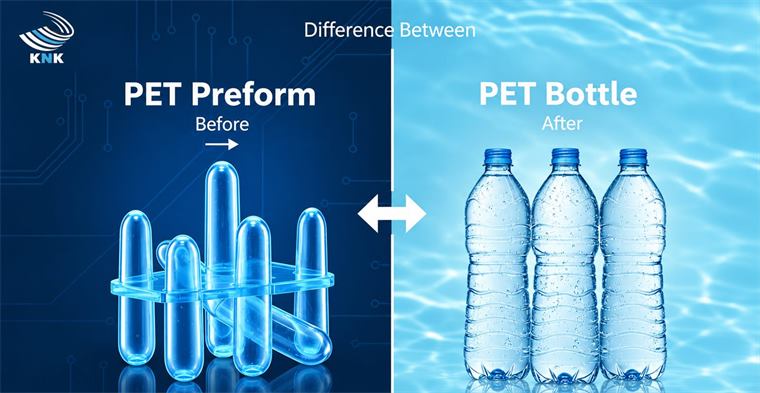
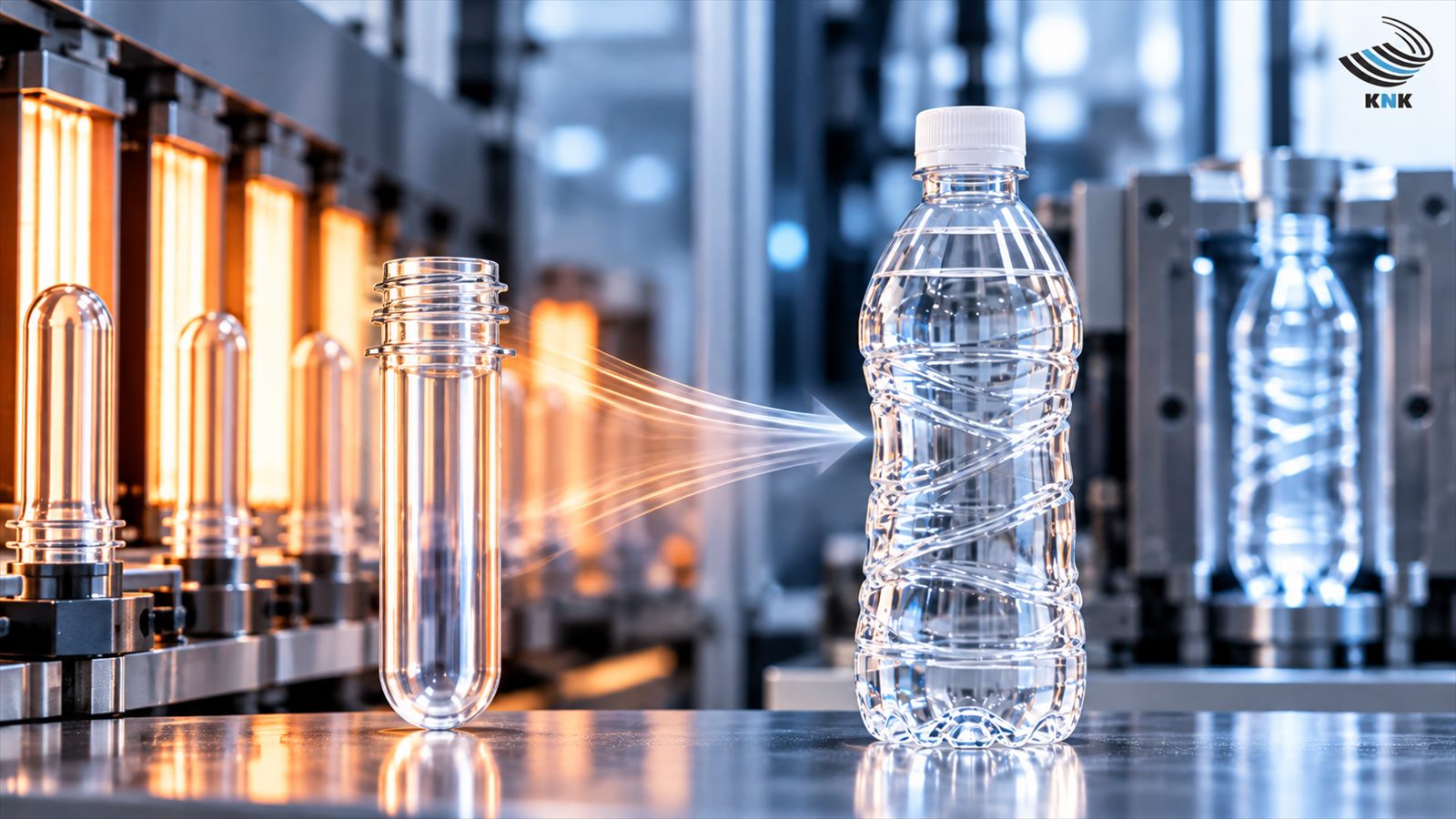
The commonly used Persian term “PET bottle blowing machine” refers more precisely to a PET Stretch Blow Moulder. In the widely used two-stage process, an injection-molded preform is reheated and converted into a bottle through Reheat Stretch Blow Moulding (RSBM). The preform body is thermally conditioned, transferred into the bottle mould, stretched longitudinally by a Stretch Rod, and expanded radially through controlled blowing. The neck finish and threads, however, largely retain the geometry created during injection molding. This is why the correct neck finish, preform geometry, and process compatibility must be considered before the preform reaches the blowing stage.
Why Is the Preform Heat Profile So Important?
Preform heating is one of the most sensitive stages in PET bottle production. The objective is not simply to make the preform “hot,” but to create a controlled Heat Profile that allows different areas of the PET body to stretch as required by the final bottle design. If heat distribution is unsuitable, material may move too quickly from one region while remaining concentrated in another, producing uneven Wall Thickness Distribution. Excessive or insufficient heating can both make the stretching process more difficult to control. There is therefore no universal temperature that applies to every PET preform; the appropriate thermal profile depends on preform geometry, weight, bottle design, equipment, and production conditions.
Stretch Rod, Pre-blow, and Blowing Pressure: Why Timing Matters
The Stretch Rod provides controlled longitudinal stretching while the PET preform expands inside the mould. At the same time, the Pre-blow stage initiates radial expansion before the main high-pressure blowing stage completes the bottle shape. These actions must be properly coordinated. If stretching, pre-blow timing, airflow, or pressure is poorly matched, PET material may be distributed unevenly between the shoulder, sidewall, and base. For this reason, quoting a single “correct blowing pressure” for all bottles would be technically inaccurate. Blow pressure, timing, heat profile, stretching sequence, and bottle geometry are interdependent process variables.
How Is PET Bottle Wall Thickness Determined?
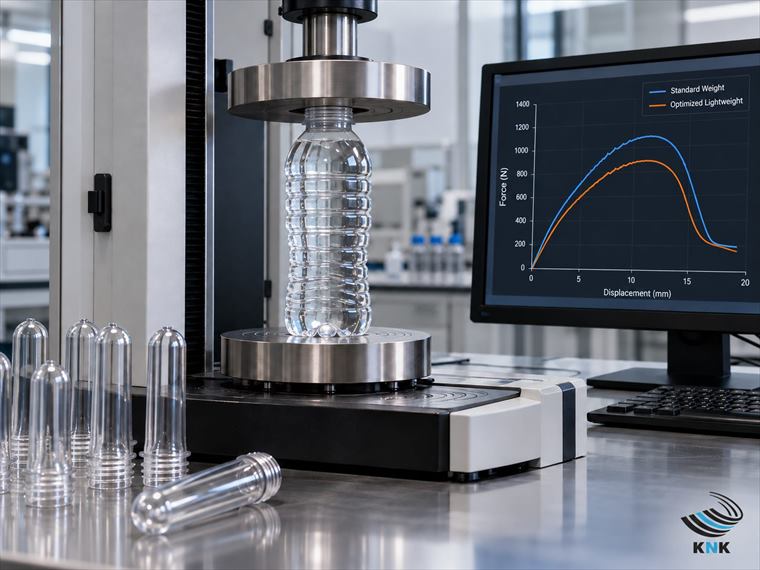
Preform weight tells us how much PET material is available, but it does not determine where that material will end up in the finished bottle. During stretch blow moulding, the material must be distributed across the shoulder, body, transition areas, and base. This distribution is influenced by preform design, temperature profile, stretch ratio, pre-blow, main blowing, and mould geometry. Consequently, two bottles with the same total weight can have very different wall-thickness profiles and mechanical performance. This is also why simply increasing preform weight does not always solve a bottle-strength problem; in many cases, better material distribution is more important than adding more PET.
Why Do PET Bottles Deform or Develop Thin Areas?
Bottle deformation can appear as an unstable base, asymmetric body, poorly formed shoulder, localized thinning, or inconsistent bottle geometry. Possible causes include non-uniform heating, excessive or insufficient stretching, an unsuitable preform-to-bottle relationship, incorrect process settings, inadequate material distribution, or a challenging bottle design. The intended application also matters. A bottle designed for carbonated beverages, for example, has different performance requirements from a standard still-water bottle, while hot-fill applications require their own bottle and process considerations. Effective troubleshooting therefore requires the bottle, preform, mould, and production conditions to be evaluated together.
Choosing the Right PET Preform for the Actual Production Line
The same preform may not behave identically on every PET blow-molding machine. Heating technology, process control, mould configuration, cycle speed, blowing stations, and machine design can differ from one line to another. When selecting a PET preform, it is therefore useful to consider not only neck finish and weight but also bottle volume and design, closure type, mould specifications, product application, and the general characteristics of the stretch blow-molding line.
At Khosh Noosh Kavir (KNK), PET preform selection is approached as more than a nominal neck-size decision. When customers provide information about the bottle design, neck finish, required weight, product application, closure, and production equipment, the preform can be assessed more accurately for the intended manufacturing conditions.
Conclusion: A Good Bottle Requires More Than a Good Preform
In PET bottle production from preforms, final quality is created by a chain of interdependent factors. The preform provides the material and initial geometry; the heat profile prepares it for forming; the Stretch Rod controls longitudinal deformation; Pre-blow and main blowing guide expansion; and the mould defines the final bottle geometry.
The most reliable production therefore depends on:
Suitable preform + controlled heating + correct stretching + properly managed blowing + compatible mould + stable process conditions
A high-quality preform delivers its real value only when it can repeatedly produce the required bottle under actual production-line conditions.